

From towering skyscrapers that touch the clouds to massive underground transit networks that keep cities breathing, modern infrastructure is the invisible backbone of our daily lives. Yet, the world of construction and design is undergoing a massive shift. As the effects of climate change intensify, urban populations skyrocket, and automation takes over the drawing board, the built environment requires entirely new approaches. Consequently, higher education institutions across the world are racing to reshape how they train the next generation of engineers.
For undergraduates entering this field today, the days of relying solely on traditional hand drafts and basic concrete mix designs are gone. Today’s academic programs are rapidly shifting from isolated mathematical exercises toward a highly integrated, technology-driven approach. Navigating this transition successfully requires a deep understanding of structural complexities, which is why a growing number of university scholars actively seek out specialized civil engineering assignment help by Myassignmenthelp to bridge the gap between heavy academic theory and modern industry standard software like Revit, BIM (Building Information Modeling), and advanced structural simulation tools.
The Shift Toward Green and Resilient Infrastructure
One of the most profound updates to university textbooks is the integration of sustainability. Historically, projects were evaluated primarily on two main metrics: cost and structural safety. While these remain foundational, a third, equally critical pillar has emerged: environmental durability.
Modern curricula no longer treat green building techniques as an optional, elective course for senior students. Instead, low-carbon concrete development, rainwater harvesting integration, and lifecycle carbon analysis are built directly into early core modules. Students are challenged to think about what happens to a structure fifty or one hundred years down the line.
Furthermore, urban planning modules now place a massive emphasis on climate adaptation. Tomorrow’s graduates are tasked with designing coastal defenses that can handle rising sea levels, porous roadways that actively mitigate flash floods, and seismic dampers that keep buildings standing during unpredictable earthquakes.
The Digital Twin Revolution: Coding Meets Concrete
The image of a civil engineer carrying nothing but rolls of physical blue blueprints is largely a relic of the past. The contemporary construction landscape is thoroughly digitalized. Leading universities are introducing data analytics, cloud computing, and basic programming into standard engineering degrees.
[Traditional Methods] ➔ 2D Drafts & Static Stress Formulas
[Modern Industry] ➔ 4D Digital Twins, Smart Sensors, & Predictive AI Models
The gold standard in today’s corporate sector is the Digital Twin—a dynamic, real-time virtual replica of a physical structure. By embedding IoT (Internet of Things) sensors into physical assets like bridges and dams, structural integrity can be monitored continuously. University labs are mimicking this by teaching students how to run stress tests in virtual environments long before a single ounce of real concrete is ever poured on a job site.
Balancing the Academic Load: Core Course Competing Demands
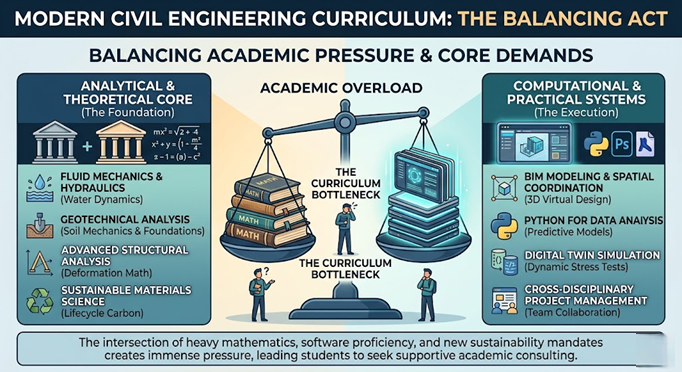
Because the industry is moving so quickly, universities keep adding new topics to the syllabus. However, the number of semesters remains the same. This creates an incredibly intense environment for students, who must master complex physical sciences while simultaneously learning cutting-edge technology.
The table below highlights the diverse array of subjects that a single student is expected to balance in a typical modern degree pipeline:
| Analytical & Theoretical Core | Computational & Practical Systems |
| Fluid Mechanics & Hydraulics (Water flow dynamics) | BIM Modeling & Spatial Coordination (3D virtual design) |
| Geotechnical Analysis (Soil mechanics and foundations) | Python for Data Analysis (Predictive maintenance models) |
| Advanced Matrix Structural Analysis (Deformation math) | Sustainable Materials Science (Lifecycle carbon metrics) |
This overwhelming intersection of mathematics, software applications, and environmental compliance frameworks creates a severe bottleneck for many scholars. This reality is particularly visible within competitive international learning hubs. To manage these overlapping project deadlines without burning out, many students turn to external academic consulting. For example, recent educational trends show a massive reliance on professional academic platforms, where busy undergraduates utilize trusted experts to safely do my assignment for me at MyAssignmentHelp, giving them the breathing room needed to focus heavily on their hands-on practical engineering lab work and field placements.
Embracing Cross-Disciplinary Project Management
Another significant evolution in the global educational landscape is the breakdown of traditional academic silos. In the professional world, a civil engineer never works in isolation. They constantly collaborate with environmental scientists, financial analysts, software developers, urban sociologists, and local government policymakers.
To prepare students for this ecosystem, universities are replacing standard individual exams with interdisciplinary capstone projects. A senior design project might bring together civil, electrical, and environmental students to plan a fully self-sustaining, off-grid public transit station. This structure forces undergraduates to build vital soft skills like cross-departmental communication, budgeting, conflict resolution, and public safety advocacy.
Global Codes and Cross-Border Engineering
Engineering is now a truly global profession. A team sitting in Toronto might design a suspension bridge to be built in Southeast Asia, using steel manufactured in Europe. Because of this interconnected supply chain, modern university programs are shifting their focus toward global compliance frameworks.
Students are increasingly taught to look beyond local municipal building rules and instead analyze international safety parameters, such as Eurocodes and ISO standards. This global tone in education ensures that a graduate who earns a degree in one hemisphere possesses the universally applicable skills needed to step directly onto a construction site in another.
Conclusion: Building the Professionals of Tomorrow
The transformation of civil engineering education reflects the changing face of our planet. As we march further into the digital age, the role of the engineer is evolving from a straightforward technical calculator into a high-level systems designer who safeguards both human life and natural resources.
By successfully balancing deep theoretical physics with agile computational skills, modern undergraduates are leaving university uniquely equipped. They are no longer just building structures; they are actively designing the smart, resilient, and highly sustainable communities of tomorrow.
Frequently Asked Questions (FAQ)
Q.1 What is BIM, and why is it so important in modern engineering degrees?
Ans: BIM stands for Building Information Modeling. It is a highly intelligent, 3D model-based process that gives architecture, engineering, and construction professionals the tools to efficiently plan, design, construct, and manage buildings and infrastructure. It is essential because it allows teams to catch structural errors virtually before actual construction begins, saving millions in physical rework.
Q.2 How are civil engineering programs addressing climate change?
Ans: Programs are completely embedding climate resilience into their design courses. Students learn to calculate changing weather patterns, use eco-friendly materials with lower carbon footprints, and design smart urban drainage systems to mitigate extreme flooding events.
Q.3 Why do engineering students often seek external academic support?
Ans: Civil engineering curriculums require a unique blend of heavy mathematics, physical lab work, and mastery over multiple complex design software platforms. Because the learning curve for these software tools is steep and project deadlines are rigid, students frequently seek external academic guidance to balance their theoretical grades with practical field training.
Q.4 What are “Digital Twins,” and how do they change the way bridges and dams are maintained?
Ans: A Digital Twin is a real-time virtual model that perfectly replicates a physical structure. By placing smart IoT (Internet of Things) sensors all over a real-world bridge or dam, engineers can track live data on vibrations, stress points, and structural shifts.
Q.5 Why is data analytics becoming a required skill for undergraduate civil engineers?
Ans: Modern infrastructure projects generate massive amounts of data—from traffic flow patterns to concrete curing temperatures. Civil engineers can no longer rely solely on static formulas; they need to know how to interpret this data.
About The Author
My name is Ruby Walker, and I am a senior academic consultant and digital content strategist at MyAssignmentHelp. With a strong background in higher education pedagogy and curriculum trends, I specialize in helping university students break down complex, technical subjects into manageable learning milestones.