
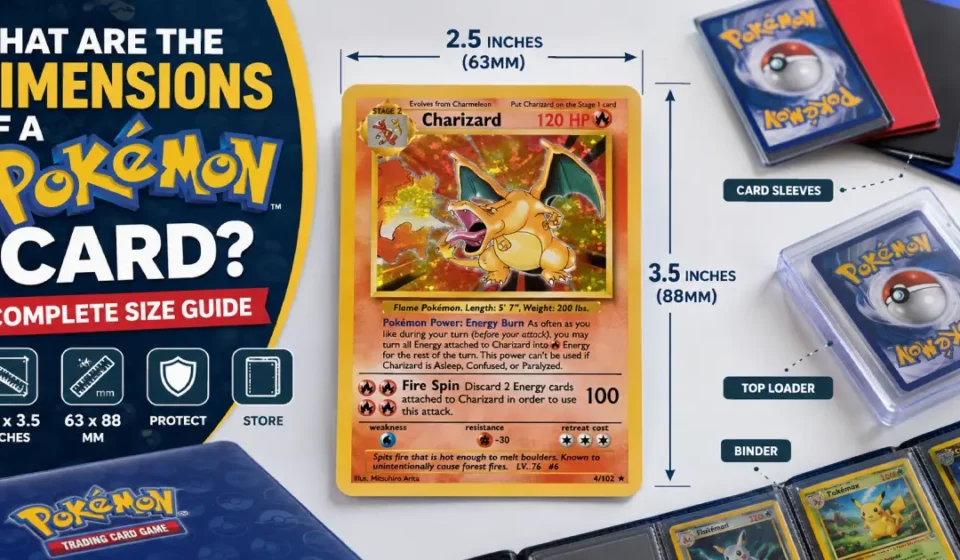

Before you buy sleeves, organize a binder, design custom cards, or verify authenticity, understanding Pokemon card dimensions is essential. Surprisingly, many collectors focus on rarity and value while overlooking the exact size of their cards. Yet dimensions play a major role in protection, storage, grading, and even identifying counterfeit cards.
According to recent collector guides, standard Pokémon cards have maintained the same dimensions since the game debuted in 1996: 63 mm × 88 mm (2.5 inches × 3.5 inches). This consistency has helped millions of players and collectors use the same sleeves, deck boxes, and binders across generations of cards.
Understanding Pokemon Card Dimensions
The world of Pokémon collecting has exploded over the last decade. Rare cards sell for thousands of dollars, grading services receive millions of submissions, and collectors constantly search for ways to preserve their investments. In this environment, knowing the exact Pokemon card dimensions becomes more important than many people realize.
Dimensions influence nearly every aspect of collecting. If a card is slightly too large or too small, it may not fit properly into protective sleeves. It can become vulnerable to scratches, corner damage, and edge wear. Collectors also use measurements as a quick method of identifying counterfeit cards because fake products often fail to match official sizing standards. A legitimate Pokémon card should feel familiar in the hand, much like a standard playing card.
The Pokémon Trading Card Game has maintained remarkable consistency since its launch. Whether you’re holding a vintage Base Set Charizard or a modern Scarlet & Violet card, the dimensions remain essentially identical. This standardization ensures compatibility across decades of products and accessories. As a result, collectors can confidently purchase storage solutions without worrying about generational changes.
Standard Pokemon Card Dimensions
The official dimensions of a standard Pokémon card are 63 mm wide by 88 mm tall, commonly expressed as 2.5 inches by 3.5 inches. These measurements apply to nearly every regular Pokémon card released worldwide, including English and Japanese editions.
When converted more precisely, the dimensions equal approximately 63.5 mm × 88.9 mm. Many manufacturers round these figures to 63 × 88 mm because the difference is extremely small and generally irrelevant for everyday collecting.
Measurements in Different Units
| Unit | Width | Height |
|---|---|---|
| Inches | 2.5 in | 3.5 in |
| Millimeters | 63 mm | 88 mm |
| Exact Metric Conversion | 63.5 mm | 88.9 mm |
| Centimeters | 6.35 cm | 8.89 cm |
These dimensions have become the standard not only for Pokémon but also for several major trading card games. The uniform sizing allows accessory manufacturers to create universal products that fit a broad range of collectible cards.
Pokemon Card Size Comparison Table
Collectors frequently compare Pokémon cards with other popular trading card games. While many games use similar dimensions, subtle differences exist that affect compatibility with sleeves and storage products.
| Card Type | Dimensions (mm) | Dimensions (inches) |
|---|---|---|
| Pokémon | 63 × 88 | 2.5 × 3.5 |
| Magic: The Gathering | 63 × 88 | 2.5 × 3.5 |
| Standard Playing Card | 63 × 88 | 2.5 × 3.5 |
| Yu-Gi-Oh! | 59 × 84 | 2.3 × 3.3 |
The table reveals why Pokémon and Magic players often share accessories. Their dimensions are virtually identical. Yu-Gi-Oh! cards, however, use a smaller format that requires specially sized sleeves and deck boxes.
Thickness and Weight of Pokemon Cards
Dimensions tell only part of the story. Thickness also affects how a card feels, performs during gameplay, and survives over time. Most standard Pokémon cards have a thickness ranging from approximately 0.25 mm to 0.76 mm, depending on the printing process, foil layers, and special finishes.
Regular cards found in booster packs tend to fall toward the lower end of that range. Premium cards featuring textured surfaces, holographic finishes, or special coatings may feel noticeably thicker. This added thickness often enhances durability while creating the premium appearance collectors love.
Weight varies slightly as well. Most standard Pokémon cards weigh between 1.7 and 1.9 grams. While these differences seem insignificant, professional grading companies sometimes use precise measurements and weight analysis when evaluating authenticity.
For collectors handling valuable cards, understanding thickness matters because some sleeves are designed for standard cards while others accommodate thicker premium versions. Choosing the correct protection ensures a secure fit without causing unnecessary stress on card edges.
Jumbo and Oversized Pokemon Cards
Not all Pokémon cards follow the standard dimensions. The Pokémon Company has released numerous jumbo cards, also known as oversized promotional cards, over the years. These cards are intended primarily for display rather than gameplay.
Modern jumbo cards generally measure around 102 mm × 146 mm (4 inches × 5.75 inches). Older oversized cards were often even larger, reaching approximately 145 mm × 200 mm.
These giant cards often appear in premium collection boxes, special promotional sets, and anniversary releases. Their larger artwork makes them particularly appealing for display purposes. However, collectors quickly discover that standard sleeves and binders are useless for jumbo cards. Specialized storage products become necessary to prevent bending and corner damage.
The evolution of jumbo card dimensions demonstrates how the Pokémon Company adapts products to collector preferences. Modern oversized cards are generally smaller than earlier versions, making storage and display considerably easier.
Pokemon Card Dimensions vs Other Trading Card Games
Trading card games often resemble different sports using the same field. The gameplay changes dramatically, but the physical cards frequently share a common format. Pokémon cards are a perfect example.
Pokémon vs Magic: The Gathering
Pokémon and Magic cards share the same dimensions of approximately 63 × 88 mm. This compatibility means collectors can often use identical sleeves, top loaders, and storage boxes for both games.
Pokémon vs Yu-Gi-Oh!
Yu-Gi-Oh! cards are noticeably smaller. Their dimensions measure roughly 59 × 84 mm, requiring different accessories. Attempting to use Pokémon sleeves for Yu-Gi-Oh! cards often results in loose-fitting protection. Conversely, Yu-Gi-Oh! sleeves are too small for Pokémon cards.
This distinction becomes particularly important for collectors who enjoy multiple trading card games simultaneously.
Best Sleeve Sizes for Pokemon Cards
Protective sleeves are the first line of defense against damage. Since Pokémon cards measure approximately 63 × 88 mm, collectors typically choose sleeves slightly larger than the card itself.
A common recommendation is 64 × 89 mm sleeves, which provide enough room for easy insertion without excessive movement. For double-sleeving, collectors often combine a snug inner sleeve with a larger outer sleeve.
Popular sleeve options include:
- Standard trading card sleeves
- Premium tournament sleeves
- Perfect-fit inner sleeves
- Matte protective sleeves
- Double-sleeve combinations
The correct sleeve size protects against fingerprints, scratches, moisture, and accidental bending. Considering the value of many modern Pokémon cards, sleeves represent one of the most cost-effective investments a collector can make.
Toploader and Binder Dimensions
Serious collectors usually go beyond basic sleeves. Toploaders and binders provide additional protection for valuable cards.
Most Pokémon cards fit comfortably into standard 3 × 4-inch top loaders, which are rigid plastic holders designed to prevent bending. Meanwhile, standard nine-pocket binder pages accommodate Pokémon cards perfectly due to the game’s consistent dimensions.
A quality storage system often follows this sequence:
- Perfect-fit sleeve
- Standard outer sleeve
- Toploader or semi-rigid holder
- Storage box or binder
This layered approach minimizes exposure to environmental damage and handling wear.
Using Dimensions to Spot Fake Pokemon Cards
Counterfeit cards remain a major concern in the hobby. One of the simplest verification methods involves measuring the card itself.
Authentic Pokémon cards consistently follow official dimensions. Cards that appear unusually narrow, short, thick, or thin may indicate counterfeiting. While dimensions alone cannot guarantee authenticity, they provide a useful first checkpoint.
Collectors should also examine:
- Print quality
- Font consistency
- Color accuracy
- Card stock texture
- Weight
- Light test performance
When multiple irregularities appear together, suspicion becomes justified. Dimensions serve as one piece of a broader authentication process.
Designing Custom Pokemon Cards
Many hobbyists enjoy creating custom Pokémon cards for gifts, fan projects, and personal collections. Accurate dimensions are crucial during the design phase.
Designers generally begin with the standard card size of 63 × 88 mm and add bleed areas for printing. Digital templates often use high-resolution settings to maintain sharp artwork and text. Creating a custom card with incorrect proportions can make it immediately noticeable beside authentic cards.
Whether you’re designing a novelty card featuring a friend or creating artistic fan content, matching official dimensions dramatically improves the final appearance. Consistency creates professionalism and helps custom creations feel authentic.
Common Mistakes Collectors Make
Many new collectors accidentally damage cards due to simple sizing misunderstandings. One common mistake involves purchasing sleeves intended for smaller card games. Another involves storing jumbo cards inside standard binders where corners become bent.
Collectors also frequently confuse rounded measurements with exact measurements. While 63 × 88 mm and 63.5 × 88.9 mm appear different, the discrepancy is minimal and generally reflects rounding rather than conflicting standards.
Additional mistakes include:
- Using oversized sleeves
- Overfilling binders
- Storing cards without sleeves
- Exposing cards to humidity
- Ignoring card thickness variations
Avoiding these errors can significantly extend the life of a collection.
Future of Pokemon Card Dimensions
The Pokémon Trading Card Game continues to evolve through new mechanics, artwork styles, and special card treatments. Despite these innovations, standard card dimensions remain remarkably stable.
Industry experts expect Pokémon to maintain its existing size standards because consistency benefits players, collectors, grading companies, and accessory manufacturers alike. A sudden change would create compatibility issues affecting millions of cards already in circulation.
While special promotional products such as jumbo cards may continue experimenting with alternative formats, standard Pokémon cards are likely to retain their familiar dimensions for many years to come. That stability remains one of the hobby’s greatest strengths.
Conclusion
Understanding Pokemon card dimensions is essential for every collector and player. Standard Pokémon cards measure 63 mm × 88 mm (2.5 inches × 3.5 inches), a format that has remained consistent since the game’s launch in 1996. This standardization allows seamless compatibility with sleeves, binders, top loaders, and grading services across generations of cards.
Whether you’re protecting a prized collection, designing custom cards, or verifying authenticity, knowing these measurements gives you a valuable advantage. Small details often make a big difference in the trading card world, and dimensions are among the most important details of all.
FAQs
1. What are the official Pokemon card dimensions?
Official Pokémon cards measure 63 mm × 88 mm or approximately 2.5 inches × 3.5 inches.
2. Are Japanese Pokemon cards the same size as English cards?
Yes. Modern Japanese and English Pokémon cards use the same standard dimensions.
3. What sleeve size fits Pokemon cards best?
Most collectors recommend 64 × 89 mm sleeves because they provide a comfortable fit while maintaining protection.
4. How large are jumbo Pokemon cards?
Modern jumbo cards are generally around 102 mm × 146 mm, while older oversized cards can be significantly larger.
5. Can card dimensions help identify fake Pokemon cards?
Yes. Incorrect dimensions can be a warning sign of counterfeit cards, especially when combined with poor print quality and unusual card stock.